Morocco by Campervan: Routes, Campsites and Practical Advice
Jump to section
- Renting a campervan in Morocco
- Smaller towns and campsites worth planning around
- Where can you sleep in a campervan?
- Routes worth considering
- Bringing your own campervan into Morocco
- Driving a larger vehicle
- Water, gas, power and connectivity
- When to go
- Campervanning with children or pets
- A practical first-trip plan
| Where to start | Rent in Marrakech, Agadir or near Casablanca, or arrive by ferry |
|---|---|
| Overnight stays | Plan around established campsites rather than assuming roadside camping is allowed |
| Favourite stops | Sidi Kaouki, Tafraoute, Ouijjane and Tata |
| Most important vehicle check | Confirm insurance, height, weight and access before departure |
| Route planning | Allow time for mountain roads, weather and service stops |
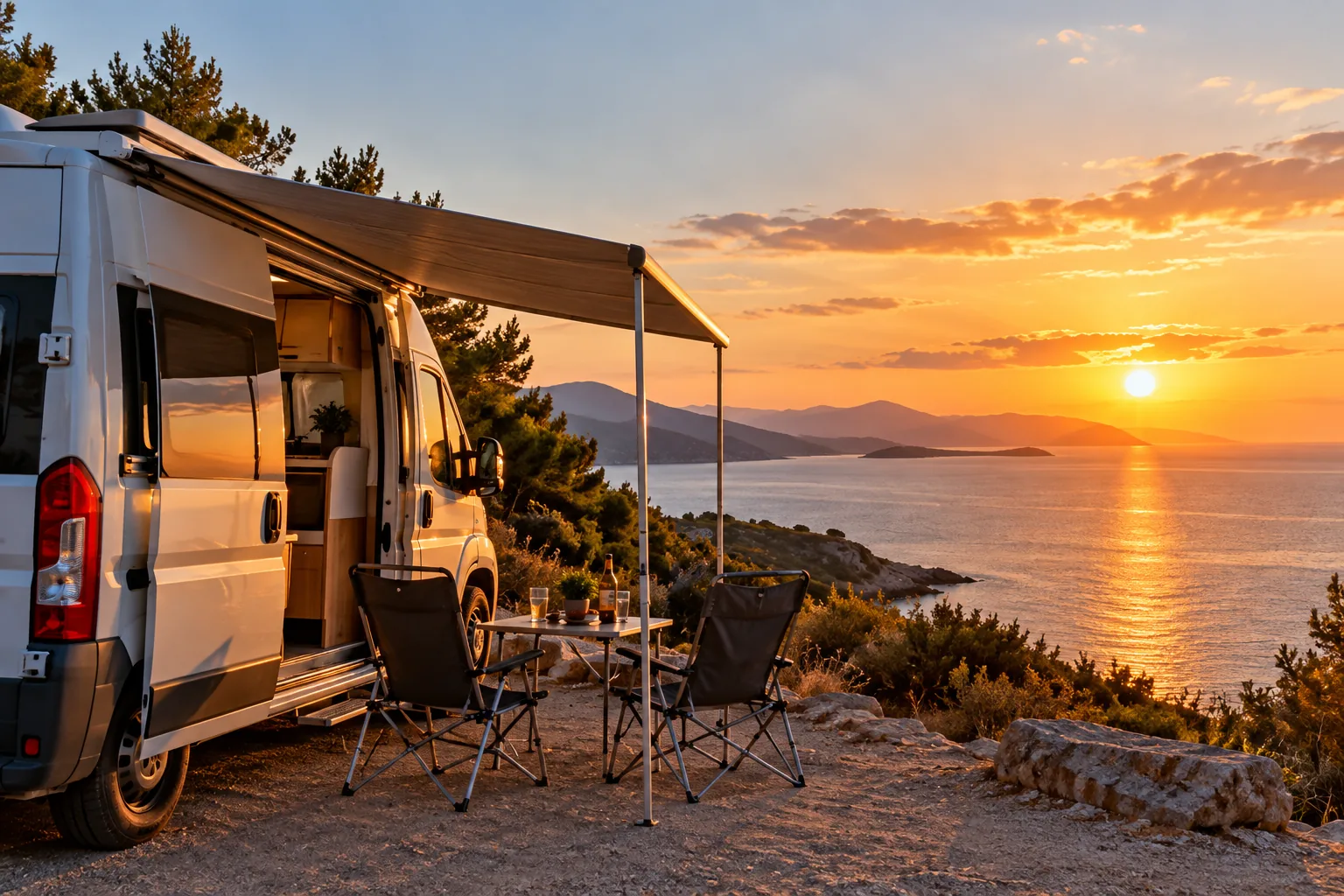
A campervan lets you take Morocco slowly: spend an extra night by the Atlantic, stop in an Anti-Atlas town or explore an oasis without changing accommodation every day. You can rent a converted van in Morocco or bring your own motorhome by ferry. Either way, the best trips are built around sensible driving days and dependable overnight stops.
Renting a campervan in Morocco
You do not need to drive your own van across Europe. Several operators rent equipped campervans within Morocco:
- VAN-AWAY Marrakech offers converted vans from its Sidi Ghanem agency, including compact options for couples or small groups.
- Baba Camper offers a converted Renault Trafic and a roof-tent 4×4, with vehicle delivery and collection advertised for Marrakech and Agadir.
- Van Maroc lists two equipped vans, collected in Dar Bouazza near Casablanca. Its advertised layouts are for two adults.
These are examples, not endorsements. Compare the actual sleeping and belted travelling capacity, toilet and shower arrangements, deposit, excess, breakdown support, permitted roads, mileage, collection and return points, and whether bedding and cooking equipment are included. Ask about one-way hire rather than assuming it is available. A roof-tent 4×4 is not the same as a self-contained motorhome, especially for families.
Smaller towns and campsites worth planning around
These are named, established camping options rather than informal beach parking. Their listings and facilities were checked in October 2026, but contact the site before travelling: opening arrangements, pitches and services can change.
- Sidi Kaouki, south of Essaouira — Camping Kaouki Beach. A small surf village where the Essaouira tourism office specifically identifies the campsite as welcoming motorhomes. A useful Atlantic stop rather than a rushed day trip.
- Tafraoute, Anti-Atlas — Camping Les 3 Palmiers. A campervan-community favourite near the town centre and pink granite hills. Campercontact lists water, electricity and waste-disposal facilities, with recent 2026 visitor reviews. Check current availability directly; this is not the same site as Camping Tazka.
- Ouijjane, near Tiznit — Sous les Palmiers Bleus. A quiet stop between the coast and the Anti-Atlas. The operator describes 25 motorhome pitches, electrical hook-ups, showers, drinking-water refill and grey/black-water disposal.
- Tata, southern oases — Camping Hyatt. An inland stop close to town, with pitches for motorhomes, electricity, showers and cassette-emptying facilities described on the operator’s website.
These stops give you different kinds of days: beach and surfing in Sidi Kaouki, granite landscapes and walking in Tafraoute, a quieter palm-grove base at Ouijjane, and oasis scenery around Tata. For longer southern routes, investigate Foum Zguid and the Drâa Valley, but do not assume that a mapped parking area is a functioning campsite. For each stop, confirm access for your vehicle’s dimensions, water and waste facilities, and whether the site is accepting arrivals.
Where can you sleep in a campervan?
An established campsite is the most dependable overnight option. Morocco has campsites in coastal areas, around major destinations and on some inland routes. The Moroccan National Tourist Office lists camping among the country’s accommodation options.
Do not treat an empty beach, car park or roadside pull-in as automatic permission to stay overnight. Local restrictions, land ownership, protected areas and enforcement vary. A parking spot where you may leave a vehicle during the day is not necessarily a place where overnight camping is permitted. Ask the campsite, landowner or local authority where necessary, and move on if instructed.
Before choosing a campsite, ask four practical questions: Can a vehicle of your size enter? Is overnight parking available? Can you refill fresh water? Is there a proper place to empty grey water and toilet waste? Electricity, showers, shade, Wi-Fi and card payment are useful extras, but should not be assumed. Call ahead in peak periods and on remote stretches.
Avoid draining wastewater onto the ground, into roadside channels or near beaches and rivers. Use designated disposal facilities. Take rubbish with you until you find a suitable bin or collection point.
Routes worth considering
These are route ideas, not fixed driving-time promises. Your pace will depend on your vehicle, stops and road conditions. For a coast-and-foothills circuit, consider Marrakech → Essaouira → Sidi Kaouki → Agadir → Tiznit/Ouijjane → Tafraoute, with two-night stops where you want to explore. For a longer southern journey, continue towards Tata via suitable paved roads after checking conditions. Do not treat these as a single-day driving itinerary.
1. Northern Morocco: Tangier, Asilah and Chefchaouen
A manageable introduction after the ferry. Explore Tangier and Asilah, then consider Chefchaouen if your van is comfortable on winding inland roads. Leave the vehicle at a suitable parking or camping area rather than trying to drive through narrow historic streets.
2. Atlantic coast: Rabat, Essaouira and Agadir
This is a useful direction for a longer, slower trip, with city breaks and time by the ocean. It is not one uninterrupted coastal road: plan each leg on an appropriate main route, especially around Casablanca and other busy urban areas. Coastal wind, salt spray and busy holiday periods can affect where you choose to stop.
3. Inland Morocco: Marrakech, the Atlas foothills and the south
Base yourself outside Marrakech, then plan shorter excursions into the foothills or towards southern valleys. Roads can become narrow, steep or exposed; some routes are unsuitable for large motorhomes. Snow, heavy rain and flood damage can disrupt mountain access. Check the road itself, not just the distance on a map.
4. Desert approaches: Ouarzazate, the Drâa Valley and established desert gateways
For a desert-focused trip, use paved routes and recognised bases for excursions. A standard campervan is not a dune vehicle. Sand, soft shoulders and remote tracks can trap even experienced drivers, and rescue can be difficult. Arrange local transport or a qualified guide for terrain beyond your vehicle’s capabilities.
Bringing your own campervan into Morocco
Many overland travellers cross from southern Spain, but campervans also reach Morocco on ferry services from other European ports, including routes from France and Italy when operating. Tangier Med is a common vehicle arrival point; other ports may suit your itinerary. Check the current route, sailing dates and vehicle acceptance directly with ferry operators. Ferry operators set their own schedules, vehicle categories and dimensions. Enter the full length and height, including a bike rack, roof box or solar installation, when comparing crossings.
Before travel, prepare:
- Passports and any visa documents required for everyone travelling.
- The driver’s valid licence and any international driving permit required for that licence.
- The original vehicle registration certificate (for example, carte grise, permiso de circulación, Zulassungsbescheinigung, kentekenbewijs, carta di circolazione or UK V5C, depending on registration country). If you are not the registered owner, including with a borrowed, financed or leased van, obtain the owner’s or finance company’s written authorisation for Morocco. Ask Moroccan customs and the owner or finance company in advance whether a legalised authorisation (procuration) or another document is required.
- Insurance that explicitly covers driving in Morocco, with acceptable proof of cover.
- The documents and declaration required for temporary admission of a foreign-registered vehicle.
Foreign-registered vehicles entering temporarily are subject to Moroccan customs formalities. The customs administration’s 2025 guide to temporary vehicle admission describes the entry record and the vehicle’s admission card, which shows its expiry date. Check the current declaration, eligibility and permitted stay with Moroccan customs before your crossing, particularly for larger motorhomes or vehicles outside the usual passenger-vehicle categories. Do not rely on an old D16 ter printout without checking the current procedure. The vehicle’s permitted stay is separate from your personal permission to remain in Morocco. Do not assume that leaving and re-entering resets a vehicle allowance, or that you can leave Morocco while the vehicle remains there without making arrangements with customs.
Licence and insurance rules depend on the country that issued your documents. Check Moroccan entry and driving requirements alongside the official advice for your own licence and vehicle registration country. For example, UK government advice specifies a 1968 international driving permit alongside a UK licence and a Green Card. Do not assume that this UK-specific combination applies identically to French, Spanish, German, Dutch or Italian drivers. Ask your insurer for written confirmation of Morocco cover and what proof must be presented at the border; check vehicle fittings, breakdown recovery and unpaved-road exclusions.
Driving a larger vehicle
Morocco drives on the right. Motorways and main roads are generally easier to plan than small mountain roads or old town centres, but traffic behaviour and road quality vary. Expect pedestrians, livestock, motorcycles and vehicles with limited lighting on some roads.
A few habits make a big difference:
- Finish longer journeys before dark, particularly on rural and mountain roads.
- Check the van’s height before parking garages, covered entrances, low branches and narrow streets.
- Keep fuel topped up before long inland stretches; do not rely on a single remote station.
- Use secure parking outside medinas and arrange a taxi or walk into the centre.
- Check weather and road closures locally before mountain or desert journeys.
- Know your vehicle’s loaded weight, tyre condition and braking limits; do not follow a car itinerary blindly.
- Moroccan motorways charge tolls. Autoroutes du Maroc accepts cash, bank cards and Jawaz; keep dirhams available in case your card cannot be used, and check the toll class for your vehicle.
For the wider rules of the road, see our car-rental and driving guide and getting-around guide.
Water, gas, power and connectivity
Water: Ask before filling a tank whether the supply is suitable for drinking. Carry a separate reserve of safe drinking water, especially in hot weather. Refill at places that expressly permit it.
Waste: Confirm both grey-water and toilet-disposal arrangements. Not every campsite has a service point for every kind of motorhome toilet.
Gas: Cylinder fittings and refill arrangements may differ from those in your home country. Do not assume you can exchange or refill a foreign cylinder locally. Check your setup and safe alternatives before departure; avoid improvised adapters or refilling arrangements.
Electricity: Check campsite voltage, socket type and whether the hook-up can safely support your equipment. Bring suitable, properly rated connectors rather than assuming every pitch has the same supply.
Internet: A Moroccan SIM or eSIM can help with navigation and campsite calls, but coverage weakens in remote valleys and desert areas. Download offline maps and keep the next stop’s contact details available.
When to go
Spring and autumn often make for comfortable mixed itineraries, though weather differs sharply between the coast, mountains and desert. Summer heat can be severe inland and in the south, while winter can bring snow and icy roads at altitude. Coastal destinations may be milder but windy.
Choose the route for the season and your vehicle, not just the month. Check the forecast again before crossing mountain passes or committing to remote roads.
Campervanning with children or pets
For families, build in shorter driving days and choose overnight stops with reliable facilities. Children need suitable approved restraints for their age and size; everyone should be seated and belted while the vehicle is moving, never in the living area without a proper travel seat.
If you are travelling with a dog, cat or ferret, plan the return journey before leaving Europe. Morocco is treated as an unlisted country under EU and Great Britain pet-entry rules, so re-entry can require a successful rabies antibody (titre) blood test at an approved laboratory. For pets returning to the EU, a valid test recorded in an EU pet passport before departure from the EU can avoid the usual three-month waiting period; otherwise, a three-month wait after the blood sample may apply before entry. Great Britain has separate documentation rules. Your pet also needs compliant identification and rabies vaccination, and entry into the EU from Morocco must be through a designated travellers’ point of entry for document and identity checks. EU non-commercial pet travel rules were updated in 2026, so confirm the applicable certificate or valid EU pet-passport documentation for your particular journey. Incorrect documents can lead to refusal of travel, return or quarantine. Check the European Commission’s pet-entry rules, the rules of your EU country of re-entry, or Great Britain’s pet-entry guidance, as applicable, with your vet well before departure.
A practical first-trip plan
For a first visit, avoid trying to see the entire country. Start with a few nights in northern Morocco, then choose either an Atlantic coast journey or an inland circuit. Stay two nights in some places instead of moving every morning. This gives you time for markets, walks and city visits, and a buffer for weather or mechanical problems.
Before each departure, know where you plan to sleep, whether the site accepts your vehicle, where you can refill water, and which road you will take. That small amount of planning makes van life in Morocco much more relaxed.
For border formalities, use Moroccan customs; for pet re-entry, use the EU or Great Britain guidance linked above. Check country-specific driving and insurance requirements before departure.
Practical Tips
- Confirm your ferry accepts your vehicle's actual length and height, including racks and roof equipment.
- Keep the vehicle's customs entry paperwork and registration details accessible throughout the trip.
- Ask campsites about motorhome access, fresh water, waste disposal and electrical hook-ups before arrival.
- Carry drinking water separately from any water intended for washing or the vehicle system.
- Plan to park outside medinas and explore town centres on foot or by taxi.